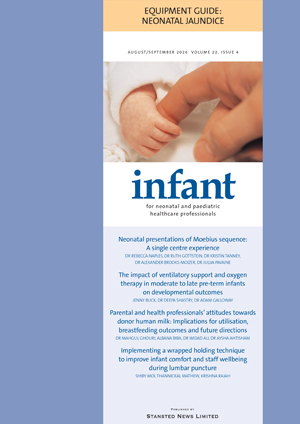

Infant Journal
for neonatal and paediatric healthcare professionals

Infant journal is the leading UK publication for the multidisciplinary team that cares for vulnerable sick or premature babies in their first year of life. Published bi-monthly, the journal contains authoritative articles with a clinical or practical bias written by experts in their field.

Abstracts of all articles are freely accessible by using the site search, or by browsing back issues. The full text of articles published from 2005 until January/February 2024 are available free of charge.

Recent issues are available on subscription via our online shop.

Current issue: February/March 2026

Trends in pulse oximetery derived heart rate variations in healthy newborns in the first few days of life
Dr Prakash Kannan Loganathan, Dr Difu Shi, Dr Giorgio Manzoni, Dr Carlton Baugh, Dr Yacov Rabi,
Heart rate (HR) forms an important aspect of newborn assessment, intensive care monitoring and early warning scores for babies in the postnatal ward and those who are transferred to the neonatal unit.1 Because term babies who are born healthy do not routinely undergo HR monitoring, there is a lack of knowledge regarding the normal values and variations in their heart rate.

Read more

Introducing virtual ward rounds in a level 2 unit to improve parental attendance: a qualitative study
Dr Mahgul Ghouri, Dr Inayat Baz, Dr Imdad Ali
Parental participation in ward rounds is a key performance indicator for neonatal care, tracked by the National Neonatal Audit Programme. Despite British Association of Perinatal Medicine guidelines promoting family integrated care, our unit has consistently underperformed in this area. Parental feedback highlighted local challenges, leading to the adoption of the NHS Attend Anywhere web-based platform to enable remote participation. Virtual ward rounds (VWR) use secure video technology to facilitate remote collaboration among neonatal care teams and to involve parents when in-person attendance is limited. This study assessed the feasibility of implementing VWRs in a level two neonatal unit, with a focus on improving access for families.

Read more

COLLABORATE trial to reduce mortality, NEC and cognitive impairment in babies born below 29 weeks’ gestation
Dr Neena Modi
We discuss COLLABORATE, a major UK-wide two-randomisation, adaptive, controlled trial to improve the care of preterm babies born below 29 weeks’ gestation. COLLABORATE aims to resolve two very longstanding uncertainties: whether preterm formula or pasteurised human donor milk is the better option to make up any shortfall in the availability of own mother’s milk, and whether human milk (own mother’s milk and pasteurised human donor milk) requires routine fortification with protein and carbohydrate. We explain the study rationale, design and importance for patients, their families and the NHS.

Read more

Strengthening organisational oversight of neonatal advanced clinical practice
Michelle Scott
This article describes the development and implementation of a set of specialty-specific competencies and new sign off process following training completion and prior to career progression for Advanced Neonatal Nurse Practitioners (ANNP) in a regional neonatal intensive care unit (NICU). The drivers to providing practitioner and organisational assurance to ensure safe and effective patient care are also explored.

Read more

Full articles available from the current issue ...

Open access:

From the January/February 2024 edition

 FREE  Preterm weaning guidance in the UK: background to the updated Bliss parent information
King C, Cairns L, Aloysius A, Tagani S, Hodgson A, Hurlston R, Xanthidis C

The weaning process, also known as introduction of complementary foods, is much more than just a change in the type of food a baby takes to obtain nutrition. It also has social, developmental, psychological, physical and medical connotations. Food and meals are the centre of many celebrations and often define cultural identity. Therefore, guiding parents to help their babies build a healthy and pleasurable relationship with food and eating is a key objective during weaning, and this can be aided by having comprehensive and unified guidelines. Such weaning publications have been provided by Bliss (a national independent parent support organisation) since 2002. The most recent update of the Bliss preterm weaning guidance features some adjusted recommendations;1 this article provides a summary of the history of Bliss weaning recommendations to date and provides an insight into the rationale for the adjusted recommendations.

 FREE  The National Neonatal Audit Programme: improving standards of care and driving quality improvement
Rachel Winch, Sam Oddie

 FREE  Perinatal emergency multidisciplinary simulation: identifying latent errors and improving communication between teams
Catherine J Douch, Eleanor Sein, Li-Yan Chow, Anne-Sophie Bayer, Angela M Quiambao, Deena-Shefali Patel

 FREE  Widening access to SHINE (Simulation to Help in Neonatal Emergencies) to include QIS students
Jessica Groucutt, Jennifer Bradford, Matthew Nash

Use our site search to find more 'open access' Infant articles

Free monthly news by email

Receive our free monthly Bulletin email, including the latest unit and product news, details of articles published in Infant journal, job opportunities and forthcoming conferences. Be assured that we will not reveal your email to anyone else, and you can remove your email address at any time.

Simply add your email address to our list.

Supplements and Advances in Practice

Here, freely available for download, are the sponsored supplements and Advances in Practice guides published by Infant.

If you are interested in sponsoring a future topic, please consult our advertising pages.

View all available supplements

Technical advances in point-of-care testing to identify haemolysed samples and reduce errors in potassium readings

Published in Volume 21 Issue 6/December 2025

Supplier Guide

Our supplier guide provides a searchable database of companies involved in supporting the care of sick and premature infants, grouped by product or service category. You can search by an area of activity, company name or by a combination of these.

SPONSORSHIPS
AVAILABLE NOW

The eleven main sectors of our Supplier Guide are available for sponsorship. See more details on our advertising page.

In the latest news...
Urgent and emergency maternity care is now safer as midwives have implemented a new approach to triage

April 13, 2026
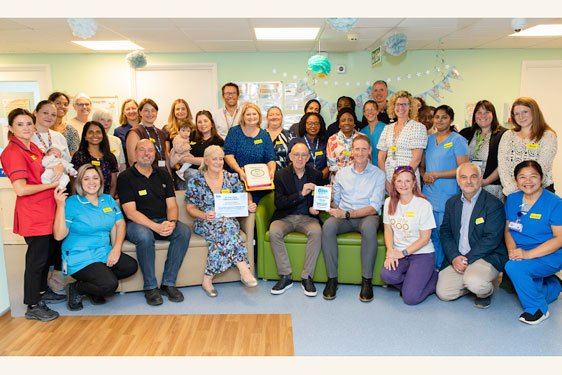
The University Hospitals of Derby and Burton NHS Foundation Trust maternity triage teams based at both Royal Derby Hospital and Queen's Hospital Burton are the first point of call for pregnancy-related concerns, offering telephone advice to 3,000 women every month, and caring for 1,600 women face to face.

Multilingual student is selected as Student Midwife of the Year 2026 by the Royal College of Midwives

April 13, 2026
Mira Waligóra at the Queen Elizabeth University Hospital, Glasgow, has been recognised for championing clearer communication and improved support for women facing language barriers. Her work has produced practical tools now used by student midwives and has influenced educational materials and curriculum design.

NHS Greater Glasgow and Clyde trials screening for spinal muscular atrophy for all newborns

April 13, 2026
The Scottish Government and pharmaceutical company Novartis are funding an evaluation to assess how well screening can detect spinal muscular atrophy earlier, allowing babies to receive treatment as soon as possible.The hope is that this test could enable earlier treatment and improve life chances.